



The Science Behind Intermittent Fasting: What the Data Really Says
If you’ve been curious about intermittent fasting science and whether it actually lives up to the hype, you’re in the right place.
Maybe your coworker swears by 16:8, your sister loves the 5:2, and your favourite health podcast makes it sound like a metabolic magic trick. But what does the fasting research data really say?
Let’s cut through the noise, ditch the bro-science, and talk about the IF benefits evidence like we’re sitting across the kitchen table with a cup of coffee.

What Is Intermittent Fasting? (Let’s Break It Down)
Before we jump into the nitty-gritty of intermittent fasting science, let’s make sure we’re all speaking the same language. Intermittent fasting (IF) isn’t a diet in the traditional sense, it doesn’t tell you what to eat, it focuses on when you eat.
Instead of constantly grazing from morning to night, you alternate between periods of eating and periods of voluntary fasting.
The most common patterns you’ll hear about include:
Time-restricted eating (16:8): You eat all your meals within an 8-hour window, say, 10 a.m. to 6 p.m., and fast for the remaining 16 hours.
5:2 method: You eat normally five days a week, then on two non-consecutive days you limit calories to around 500 to 600.
Alternate-day fasting: You switch between regular eating days and days where you either fast completely or have a very small meal (under 500 calories).
24-hour fast (Eat-Stop-Eat): Once or twice a week, you go a full 24 hours without food.
Sounds simple, right? In practice, it can take some getting used to, but the real question is whether that simplicity translates into real, science-backed results.
To answer that, we need to look at what happens inside your body when you stop eating for a while.
The Intermittent Fasting Science: What Happens Inside Your Body
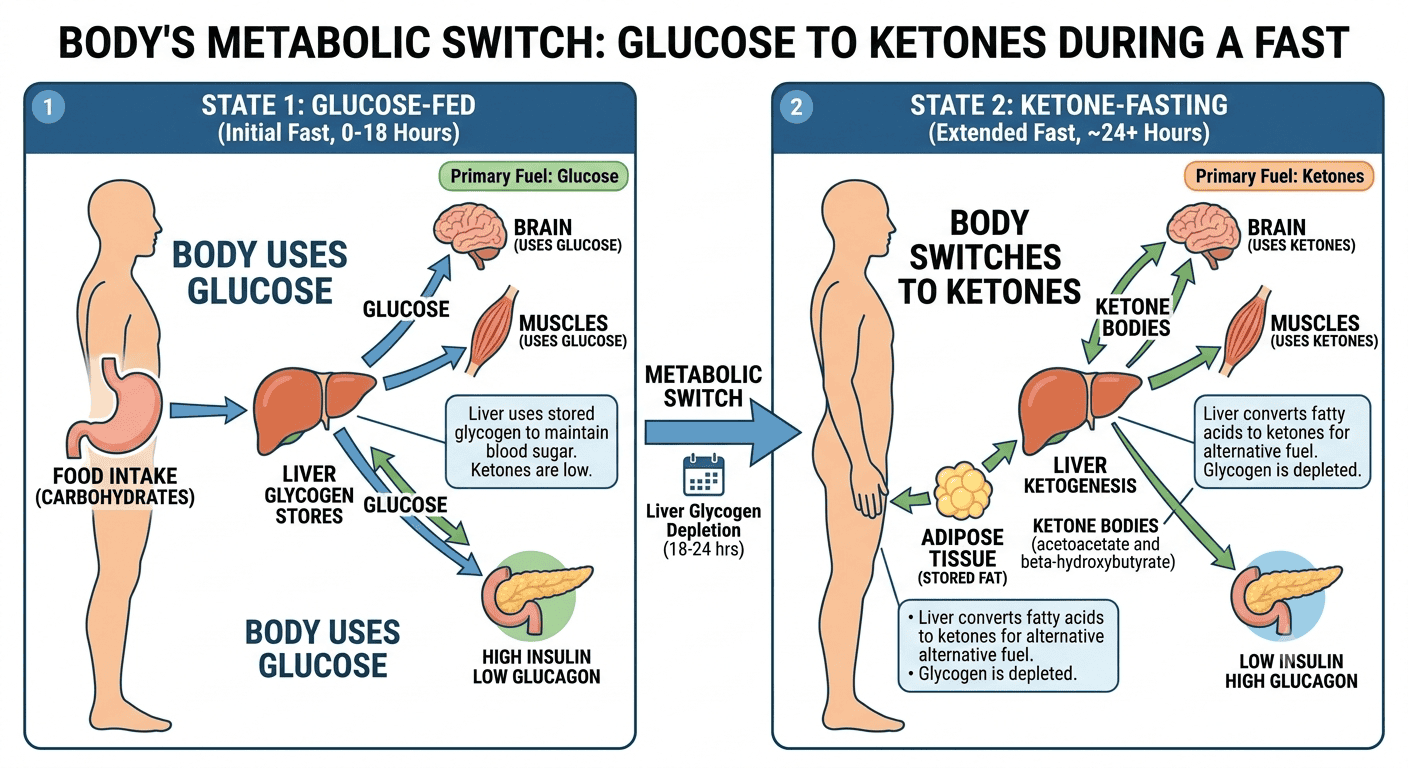
This is where the intermittent fasting science gets seriously cool. When you eat throughout the day, your body runs mainly on glucose (sugar) from food.
Your insulin levels stay elevated to shuttle that glucose into cells. But after several hours of not eating, typically around 8 to 12 hours, something called the “metabolic switch” flips.
Once your body has used up its stored liver glycogen, it starts burning fat for fuel, producing molecules called ketones. You’re essentially shifting from sugar-burning mode into a gentle fat-burning state.
This isn’t starvation, it’s a natural metabolic shift our ancestors experienced regularly when food wasn’t available 24/7.
But the fasting research data reveals even more beneath the surface:
Insulin sensitivity improves: With fewer eating opportunities, insulin levels drop, which can help your cells become more responsive to insulin over time.
Cellular repair kicks in: Fasting triggers autophagy, a process where cells clean out damaged components and recycle them. Think of it as a deep spring cleaning for your cells.
Gene expression shifts: Studies show that fasting can influence genes related to longevity and stress resistance.
One of the most respected reviews in the field, published in The New England Journal of Medicine, pulled together decades of intermittent fasting science and confirmed that this metabolic switch is at the heart of many of the benefits people experience.
External link: https://www.nejm.org/doi/full/10.1056/NEJMra1905136 It’s not magic; it’s biology that we’ve simply forgotten in the age of endless snacking.
Weight Loss and Metabolic Health: What the Fasting Research Data Really Shows
Let’s address the number-one reason most people try IF: weight loss. And this is where the IF benefits evidence is quite solid, but it’s important to understand why it works.
Plenty of high-quality trials show that intermittent fasting can lead to weight loss, typically in the range of 3 to 8% of body weight over 3 to 24 weeks.
When you dig into the fasting research data, you’ll notice a common theme, most people naturally eat fewer calories without having to count every bite.
By shrinking the eating window, you often drop the late-night snacks and mindless munching that add up.
A systematic review found that intermittent fasting interventions were effective for short-term weight loss in overweight and obese adults, with results comparable to continuous calorie restriction. [External link: https://pubmed.ncbi.nlm.nih.gov/30485920/
But the real story goes beyond the scale. The intermittent fasting science points to meaningful improvements in metabolic health markers:
Visceral fat reduction: Several studies observed a decrease in harmful belly fat even without intentional calorie counting.
Better blood sugar control: Fasting insulin levels often drop, and insulin sensitivity improves, which matters hugely for metabolic syndrome and type 2 diabetes risk.
Improved cholesterol and triglycerides: Many (though not all) studies report favourable changes in blood lipid profiles.
It’s not a guarantee for everyone, individual responses vary, but the IF benefits evidence suggests that for many people, time-restricted eating can be a practical, no-fuss way to nudge their body toward healthier metabolic function without obsessing over every macro.
If you’re looking for a step-by-step guide to get started, check out our post on how to start intermittent fasting for weight loss, it walks you through the first week in a gentle, sane way.
IF Benefits Evidence Beyond the Scale: Brain Health, Longevity, and Inflammation
Losing a few pounds is nice, but what gets researchers truly excited is the possibility that intermittent fasting science might help us age more gracefully and keep our brains sharper.
Now, a lot of this fasting research data comes from animal studies, so we need to stay humble about what that means for humans. Still, the findings are intriguing enough to be worth a conversation.
In laboratory animals, intermittent fasting has been shown to:
Extend lifespan and delay the onset of age-related diseases.
Increase levels of brain-derived neurotrophic factor (BDNF), a protein that supports the growth of new neurons and protects existing ones.
Reduce markers of oxidative stress and inflammation throughout the body.
What about people? Human trials are smaller and shorter, but the IF benefits evidence is starting to stack up.
Some studies report improved verbal memory, better executive function, and a reduction in markers of systemic inflammation after several months of time-restricted eating.
A long-running area of study looks at whether these fasting protocols could help protect against Alzheimer’s and Parkinson’s disease, though we’re not there yet.
Harvard Health has a wonderfully balanced rundown of how IF may affect everything from brain health to chronic disease risk. https://www.health.harvard.edu/blog/intermittent-fasting-surprising-update-2018062914156]
For many people, the mental clarity they feel during a fast, that “light, focused” sensation, becomes a benefit as appealing as any number on the scale. We talk more about that phenomenon in our article on fasting and mental clarity, where we dig into how ketones might fuel your brain differently.
Potential Downsides: What the Data Says About Risks and Who Should Avoid It
Of course, no honest dive into intermittent fasting science would be complete without talking about the potential pitfalls. The fasting research data isn’t all sunshine and flat bellies, there are real downsides that deserve your attention.
Common, usually short-term side effects include:
Hunger and irritability (hello, hanger) during the first week or two.
Headaches, fatigue, and brain fog as your body adapts.
Digestive discomfort, like constipation, if you’re not drinking enough water or eating fibre-rich meals.
More seriously, intermittent fasting isn’t for everyone. The evidence clearly advises against it if you:
Are pregnant, breastfeeding, or trying to conceive.
Have a history of eating disorders.
Are underweight or struggling with disordered eating patterns.
Have certain medical conditions, such as advanced diabetes, that require careful meal timing, unless you’re working closely with a doctor.
Recently, a preliminary study presented at a 2024 American Heart Association conference grabbed headlines by linking an 8-hour eating window to a 91% higher risk of cardiovascular death. https://newsroom.heart.org/news/8-hour-time-restricted-eating-linked-to-a-91-higher-risk-of-cardiovascular-death
It sparked a lot of fear, and a lot of confusion. It’s crucial to note that this was an observational abstract, not a peer-reviewed published study, and the eating window was self-reported years earlier.
The people doing time-restricted eating might have had other risk factors the analysis couldn’t fully account for. The lesson? More intermittent fasting science is needed before we draw firm conclusions. Use the data to stay informed, not terrified.
If you’re a woman with a complex hormonal picture, you might wonder whether IF works differently for you, we explore that in our dedicated guide is intermittent fasting safe for women?

Practical Tips to Get Started with Intermittent Fasting (Based on Science)
If the IF benefits evidence has you curious, don’t just dive into a 20-hour fast tomorrow and hope for the best.
The fasting research data consistently shows that gradual, personalised approaches work better and keep side effects to a minimum. Here’s how to set yourself up for success:
Start with a gentle window. Try 12:12 (12 hours eating, 12 hours fasting) for a few days, then gradually nudge toward 14:10 or 16:8. Your body’s hunger hormones take time to recalibrate.
Hydrate like it’s your job. Water, herbal teas, and black coffee (without sugar or cream) are your best friends during fasting hours. They keep energy up and headaches at bay.
Make your eating window nutrient-dense. IF isn’t a licence to eat junk. Focus on protein, healthy fats, fibre, and loads of colourful veggies to support satiety and nourish your cells.
Listen to your body’s signals. If you feel dizzy, extremely fatigued, or constantly obsessed with food, your approach might be too aggressive, pull back.
Stay busy. Fasting hours often feel longest when you’re bored. Plan a walk, a work task, or a call with a friend to distract yourself.
While you experiment, avoid the common pitfalls that make people throw in the towel early. We break them down in our post on common intermittent fasting mistakes. little tweaks can make a huge difference.
Key Takeaways: What the Science Tells Us About Intermittent Fasting
Let’s zoom out and summarise what the intermittent fasting science and fasting research data are really telling us right now, without exaggeration.
IF works primarily by helping many people eat fewer calories in a sustainable, non-obsessive way. That’s the main driver of weight loss.
The metabolic switch into fat-burning and ketone production likely drives additional improvements in insulin sensitivity, cellular repair, and inflammation reduction.
The IF benefits evidence for brain health and longevity is exciting but still largely based on animal studies; human data is growing but not yet definitive.
Most healthy adults can safely try IF, but it’s not recommended during pregnancy, for those with a history of eating disorders, or for certain medical conditions without supervision.
Headline-grabbing risk claims must be weighed against the quality of the data, one observational abstract doesn’t overturn years of controlled trials.
In short, intermittent fasting is a tool, not a miracle. When used wisely and personalised to your life, it can be a powerful lever for better health.
The science backs its short-term benefits, and the long-term story is still being written, which is exactly why staying curious and critical is so important.
Still have questions about how intermittent fasting science applies to your life? We’d love to hear from you.
Whether you’re wondering about a specific protocol or just need someone to bounce ideas off, reach out to us, no question is too small.
Contact us at [email protected] and we’ll help you make sense of the data, one meal (or missed meal) at a time.