



How to Measure and Optimize Your Circadian Rhythm at Home
If you’ve ever felt like your energy is dragging at the wrong times or you’re wide awake when you should be sleeping, you’ve probably wondered what it actually takes to optimize your circadian rhythm without stepping foot in a sleep lab.
Here’s the good news: you don’t need expensive equipment or a medical degree. With a few gentle, at-home tools and some self-awareness, you can measure your internal clock and make small, powerful shifts that help your body feel more alive, more rested, and way more in sync.
Let’s walk through it like we’re sitting across from each other at the kitchen table, no jargon, just real, usable steps.

What Is Your Circadian Rhythm, Really?
Your circadian rhythm is an internal 24-hour clock running quietly in the background of your brain and body. It dictates when you feel sleepy, when you feel alert, when your digestion hums along best, and even when your body temperature naturally rises or falls. This master clock is located in a tiny region of your brain called the suprachiasmatic nucleus (SCN), and it synchronizes with the light-dark cycles of the world around you.
Think of it as the conductor of a grand orchestra. When the conductor’s tempo is steady, every instrument, your hormones, metabolism, immune system, and sleep drive, plays in harmony.
When life throws the rhythm off (hello late-night scrolling, shift work, or weekend sleep binges), the symphony gets messy. You might notice groggy mornings, 3 p.m. slumps, cravings, or lying in bed with a tired body but a racing mind. To optimize circadian rhythm well, you first need to understand what it’s actually doing.
Why Bother to Optimize Your Circadian Rhythm?
We often treat sleep as a thing we do after everything else is finished, but when you start to optimize circadian rhythm, you touch every corner of your health. A well-timed internal clock can:
Sharpen your focus and productivity during the day
Improve digestion and metabolic health
Balance mood and emotional resilience
Support a stronger immune system
Help hormones like melatonin and cortisol follow their natural curves
A misaligned rhythm, on the other hand, is linked with higher risks for metabolic issues, low-grade inflammation, and mental fog. The beauty is that small, everyday experiments can guide your body back to a steady beat. And it all starts with measurement.
Internal link: If you’re curious about the emotional side of sleep, take a look at our article [Sleep Hygiene and Stress: Breaking the Cycle](https://homegrownfutures.com/blog/sleep-hygiene-stress).
Step 1: Measure Your Circadian Rhythm at Home
Before you can shift anything, you need a baseline. To measure circadian rhythm accurately at home, you’ll use a mix of simple logs, wearable tech if you have it, and some mindful self-checks. No single gadget tells the whole story, but layering a few methods gives you a surprisingly clear picture.
Start a “time-stamped” sleep-wake diary for one week.
Grab a notebook or a notes app. Every morning, jot down:
What time you went to bed
Roughly when you fell asleep (guess honestly)
What time you woke up (no alarm, if possible)
How you felt within 30 minutes of waking (groggy, alert, hungry, cold)
Any middle-of-the-night awakenings
Also note your energy peaks and valleys throughout the day, like that 10 a.m. superpower focus or the 2 p.m. desire to nap under your desk. Patterns will surface faster than you think.
Add wearable data if you have it.
Devices like an Oura Ring, Whoop band, Fitbit, or Apple Watch can estimate sleep stages and track resting heart rate and body temperature trends. Core body temperature hits its minimum (the nadir) a couple of hours before your natural wake-up time, then starts rising. If your wearable shows a temperature low at 3 a.m. and you wake at 6:30 a.m. feeling refreshed, your rhythm might be well-aligned. If the low is shifting erratically or if your heart rate stays high overnight, there’s a clue that something’s off.
Pay attention to body signals without gadgets.
You can also “listen” to your clock through simple observations:
Do you get cold hands and feet in the evening? That’s your body cooling down for sleep.
Does the sight of breakfast make you slightly nauseous before 8 a.m.? That can be a sign your digestive rhythm hasn’t kicked in yet.
Try this low-tech check: On a day without alarms, see when you naturally fall asleep and wake. Repeat for a few days. The midpoint of your natural sleep window is a rough stand-in for your chronotype, which we’ll dive into next.

Step 2: Home Chronotype Testing – Discover Your Inner Animal
You’ve probably heard someone say, “I’m an early bird,” or “I’m a total night owl.” That’s their chronotype talking.
While not a clinical diagnosis, home chronotype testing gives you a friendly, research-backed lens to understand your body’s preferred timing. It’s like finding out your circadian personality, and it can radically shift how you optimize circadian rhythm by aligning tasks with your biological strengths.
The most widely used questionnaire is the Morningness-Eveningness Questionnaire (MEQ), a series of questions about when you’d prefer to wake, exercise, and tackle mental work. You can find free versions online with instant scoring.
Another powerful tool is the Munich ChronoType Questionnaire (MCTQ), which calculates your mid-sleep point on free days, a more behavior-based measure. Both are accessible, take less than 10 minutes, and count as home chronotype testing gold.
Once you get your result, you’ll likely fall into one of these categories popularized by sleep researcher Dr. Michael Breus (and you might recognize them):
Lion: Early riser, morning peak, tapers off in the evening.
Bear: Follows the sun, gets an afternoon dip, generally the most common.
Wolf: Late riser, evening creativity spike, struggles with early mornings.
Dolphin: Light sleeper, often with an irregular sleep pattern, may deal with a buzzy brain at night.
Knowing your type isn’t about labeling yourself, it’s about permission. If you’re a wolf living in a lion’s 6 a.m. world, simply forcing yourself to bed earlier won’t work without additional light and behavior shifts. Instead, you’ll craft strategies to gently nudge your rhythm while honoring your wiring.
External link: For a thorough overview of chronotypes and their impact, check out the [Sleep Foundation’s guide to chronotypes] (https://www.sleepfoundation.org/how-sleep-works/chronotypes).
Internal link: Discover how to match your meal timing to your inner clock with our post on [Chrononutrition: Meal Timing for a Better Body Clock](https://homegrownfutures.com/blog/chrononutrition-meal-timing).
Step 3: Use Data to Optimize Your Circadian Rhythm
Now the fun part, taking your sleep log, wearable insights, and chronotype home testing results to actually optimize circadian rhythm. You’re not going for perfection; you’re aiming for a rhythm that feels sustainable and supportive.
Set a consistent anchor time.
Pick a wake-up time that you can stick to, even on weekends, within a 30-minute window. This is the single most powerful lever. Morning light is the reset button for your SCN. Get outside within 30 minutes of waking for at least 10 to 20 minutes. No sunglasses, no window glass. If you’re a wolf needing to shift earlier, that morning light is non-negotiable. If you’re a lion who wants to stay awake later for social events, you’ll need afternoon and early evening light exposure instead.
Time your light and darkness strategically.
After sunset, dim the lights and switch to warm, low-level illumination. Wear blue-light-blocking glasses if you must be on screens. Darkness triggers your pineal gland to start releasing melatonin. For optimal rhythm shifting, you want bright days and truly dark nights. Even a small night-light or an uncovered window with streetlight can fragment your sleep architecture. If you’re trying to measure and shift, blackout curtains and a sleep mask are worth it.
Align meals with your clock.
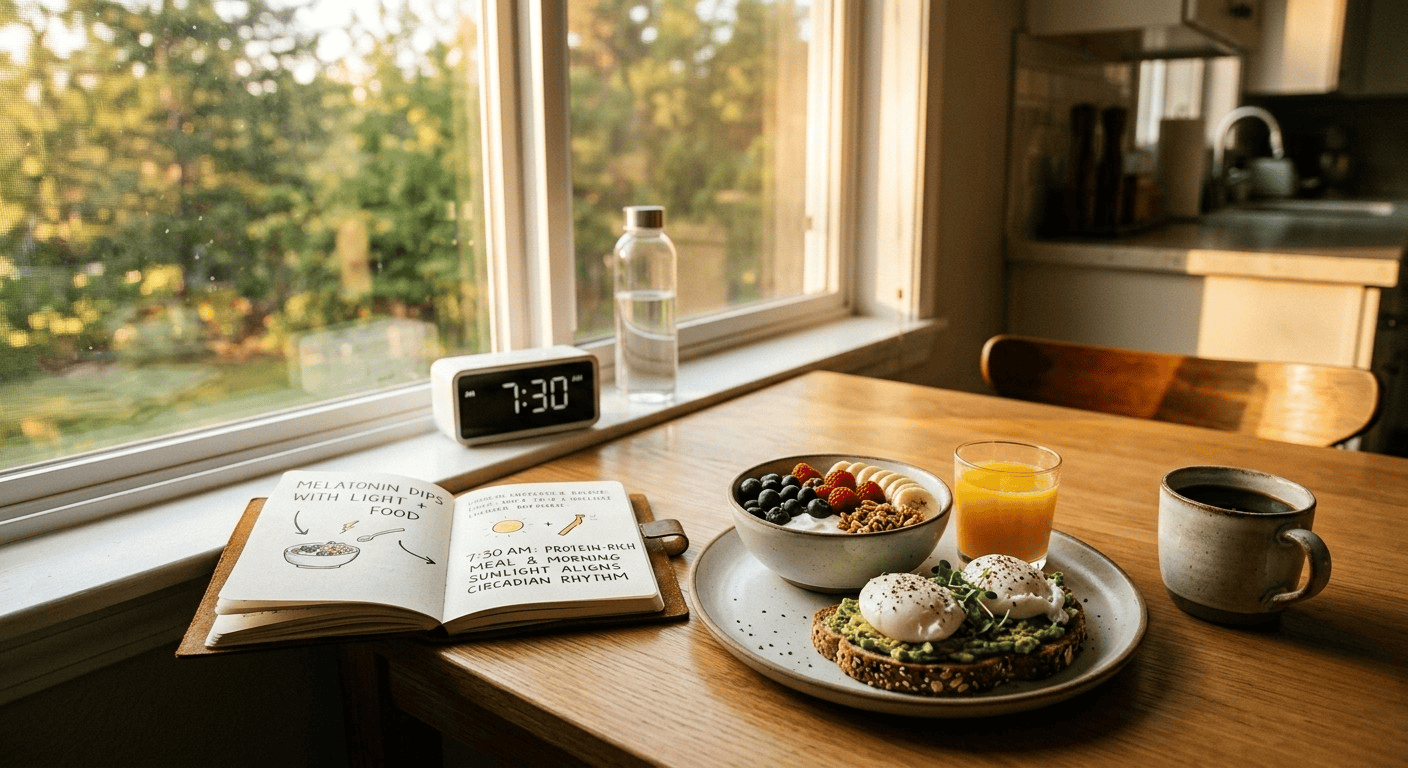
Your digestive system has its own peripheral clocks. Eating breakfast at roughly the same time each morning tells your body “day is starting.” Avoid large meals within three hours of bedtime. Try to front-load calories so your body isn’t busy digesting when it should be winding down. It’s a gentle but profound way to optimize circadian rhythm without changing anything else.
Daily Habits to Lock In a Healthy Rhythm
Once you’ve measured your starting point and made the big moves, daily routines cement the change. Think of these as the rhythm-keepers.
Move with the light.
Exercise is a zeitgeber (a time cue). Morning exercise reinforces an early rhythm; evening high-intensity workouts can delay sleep in sensitive individuals. If you’re a wolf, a moderate afternoon workout may work best. Pay attention to how exercise timing affects your ability to fall asleep that night, your own data is your best guide.
Create a sunset ritual.
Starting about 60 to 90 minutes before your target bedtime, initiate a wind-down sequence. That might look like dimming lights, putting your phone to charge in another room, drinking a warm (non-caffeinated) tea, or doing a brain dump journal. These cues train your nervous system that sleep is coming. Consistency matters far more than the specific activity.
Regulate room temperature.
A drop in core body temperature is required for deep sleep. Keep your bedroom cool (around 65°F or 18 to 19°C is often recommended, though personal preference rules). A warm bath an hour before bed can actually help because the post-bath cooling effect deepens sleep onset.
Respect your wind-down and wake-up even on tough days.
There will be nights when life gets messy, a sick kid, a deadline, a Netflix binge. One off night won’t ruin everything. It’s the pattern that counts. The next day, prioritize your anchor wake-up time and morning light to slide back on track quickly.
Internal link: If you want to dive deeper into the power of a nightly wind-down, our guide [How Evening Wind-Down Routines Optimize Your Sleep](https://homegrownfutures.com/blog/evening-wind-down-sleep) is full of practical scripts.

Troubleshooting: When Your Rhythm Feels Off
Even after you optimize circadian rhythm, you might hit a few bumps. Let’s troubleshoot like friends.
“I’m exhausted but wired at bedtime.”
This often signals a misalignment where your biological night hasn’t started yet. Check your light exposure after 8 p.m.are screens on full brightness? Are you working late under bright overhead lights? Dim everything way down. Also examine your stress levels; a cortisol spike in the evening can delay sleep onset. A short breathing exercise or a “worry list” can help.
“I wake up at 3 a.m. and can’t go back to sleep.”
Early morning wakings can be linked to a drop in blood sugar, an overtaxed stress system, or an aligned rhythm that’s simply shorter than you need. Experiment with a small protein-fat snack before bed (like a spoonful of almond butter) to stabilize blood sugar overnight. Also, assess alcohol, it often disrupts the second half of the night.
“I’m a shift worker or a new parent.”
Real life sometimes imposes a schedule that’s at odds with the sun. In these cases, focus on anchoring with light and dark as much as you can. Use blackout shades during daytime sleep, wear sunglasses on the way home to limit light that tells your brain “it’s morning,” and keep meal timing as consistent as your schedule allows. Small pockets of routine still signal safety to your body.
“I think I have a real circadian rhythm disorder.”
If you’ve been consistent with the home strategies for several weeks and still feel deeply misaligned, especially with extreme sleep timing that causes distress, it might be time to see a sleep specialist. Conditions like delayed sleep phase disorder are real and treatable. Home measurement gives you powerful insight, but professional guidance closes the gap when self-help isn’t enough.
External link: Learn the science behind your clock from the National Institute of General Medical Sciences (https://nigms.nih.gov/education/fact-sheets/Pages/circadian-rhythms.aspx).
External link: For broader sleep health guidelines, the CDC’s Sleep and Sleep Disorders resource (https://www.cdc.gov/sleep/index.html) is a reliable, up-to-date place to start.
Key Takeaways
Before we part, let’s pull everything together into a little cheat sheet you can screenshot or scribble on a sticky note:
To optimize circadian rhythm, start by gathering data, use a sleep-wake diary, wearable trends, and body observations to measure circadian rhythm at home.
Perform home chronotype testing using a free MEQ or MCTQ to identify whether you’re a lion, bear, wolf, or dolphin. Knowing your type shapes your strategy.
Set a consistent wake-up time and flood your eyes with morning light to anchor your clock. Dim evenings and respect darkness as a biological cue.
Align meal timing and exercise with your natural energy peaks, breakfast tells your body it’s day, and a wind-down routine eases you into night.
When your rhythm stumbles, troubleshoot with light adjustments, temperature, and stress management, and don’t hesitate to seek professional help if needed.
Ready to Take the Next Step?
Measuring and tweaking your circadian rhythm at home is one of the most loving, high-impact things you can do for your energy, mood, and long-term health.
You don’t have to do it perfectly, just start with one change, give it a week, and notice how your body responds. Over time, those tiny shifts compound into a rhythm that feels like your own natural song.
Have questions? Want to share what you discovered from your home chronotype testing? Or maybe you’re dealing with a tricky schedule and need a compassionate, science-informed ear? Reach out, we’d genuinely love to hear from you.
Contact us at [[email protected]] for inquiries, personal rhythm challenges, or just to say hi. Let’s keep the conversation going.