

DIY Citizen Science for Kids: 5 Safe, Fun Biology Projects to Try at Home
If you’ve ever wanted to spark a love for biology without cracking open a dry textbook, DIY citizen science for kids is your secret weapon.
Imagine turning your backyard into a living laboratory where children become real scientists, collecting data, making discoveries, and contributing to global research.
This kind of teaching biology at home combines hands-on exploration with the thrill of helping actual scientists, and all the safe biology experiments children do require little more than curiosity and a few household items.
Let’s dive into how you can turn today’s playtime into tomorrow’s data point.
What Is Citizen Science (and Why It’s Perfect for Teaching Biology at Home)
Citizen science is exactly what it sounds like: regular people (that’s you and your kids) partnering with professional researchers to gather real-world data.
Your child might count butterflies for a pollination study, track when the first daffodil blooms, or report the birds that visit your feeder, all data that scientists genuinely need.
It’s a bridge between the kitchen table and the lab, and it makes teaching biology at home feel less like a lesson and more like an adventure.
Why does this matter so much for learning? First, kids see a purpose. Knowing that their scribbled bird tally will help someone write a research paper flips a switch from “Do I have to?” to “Can we do it again?”
Second, it builds science skills naturally: observation, data recording, pattern recognition, and communication.
Third, it demystifies biology. Instead of memorizing the parts of a flower from a diagram, they watch a bee visit a real sunflower and suddenly they’re asking why some petals are more popular than others.
A fantastic starting point for finding projects is [SciStarter] (https://scistarter.org/) (external link), a database of citizen science opportunities you can filter by age, topic, and location.
You might also enjoy our post on Creating a Backyard Wildlife Habitat to make your outdoor space even more inviting for data-gathering critters.
Staying Safe While Doing Real Science: Safe Biology Experiments Children Can Do
Before we jump into the fun part, let’s talk safety, because even the most gentle pond dip deserves a few ground rules.
The beauty of DIY citizen science for kids is that it typically involves observing, not handling.
Still, we want these safe biology experiments children do to stay safe. Here are my non-negotiable tips:
Adult supervision always. Your presence turns a potential mishap into a teachable moment.
Dress for the job. Closed-toe shoes, long sleeves when near brambles, and a hat on sunny days.
Gloves are your friends. Use garden gloves when turning over rocks or sifting through leaf litter.
Hand hygiene. Soap and water after every outdoor session, even if you only touched a notebook.
Know your allergies. Check pollen counts, watch for stinging insects, and keep an epinephrine auto-injector handy if your child has severe allergies.
Stay in your zone. Backyard counts and local park visits are perfect; never let a child collect samples near roadsides, polluted drains, or steep riverbanks.
If your little scientist wants a closer look at what they’ve found, a simple magnifying glass or a kid-friendly microscope can do wonders without putting anyone at risk.
Our roundup of the Top 10 Microscopes for Young Scientists includes models that are tough, affordable, and easy to use, ideal companions for safe biology experiments children can set up on the kitchen counter.
Project 1: Backyard Bird Count – A Feathered Start (DIY Citizen Science for Kids)
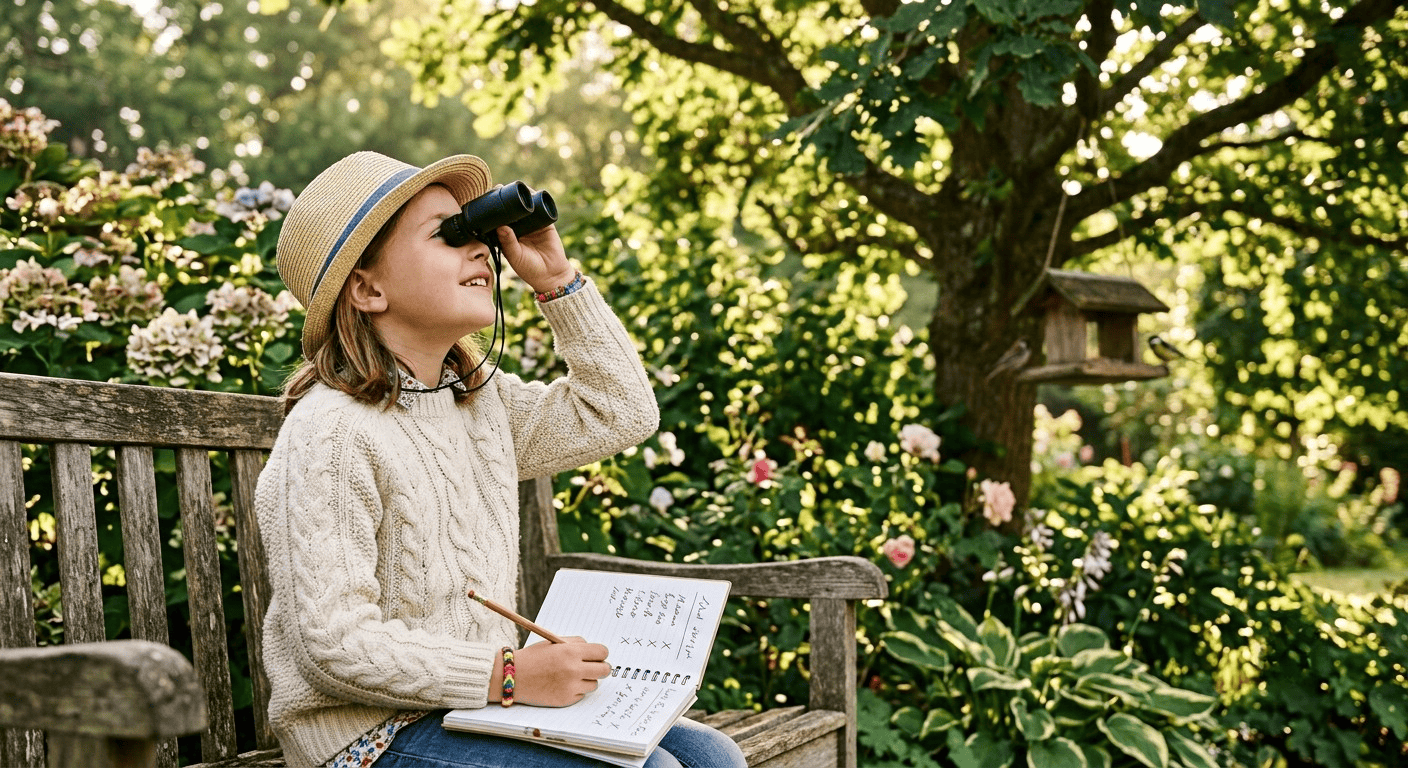
If you can look out a window, you can do this project. All you need is a notebook, a pencil, and maybe a pair of binoculars if you have them.
The Cornell Lab of Ornithology runs [eBird] (https://ebird.org/home) (external link), the world’s largest biodiversity-related citizen science project.
You simply note which bird species you see, how many, and when, then submit your checklist through the free app.
How to do it safely: Stay in your yard, on a balcony, or at a nearby park bench. No handling of wild birds, just watching. Teach kids to stay still and quiet, which is a great skill in itself. If you put out a bird feeder, place it where you can see it from inside and clean it weekly to prevent disease spread among birds.
Biology tie-in: This is living ornithology. Your child will start noticing beak shapes, feeding habits, and seasonal migrations. Over time, you can graph “our” bird counts and compare them with historical data, a perfect real-world math-and-science mash-up.
Project 2: Pollinator Patrol – Bees, Butterflies & Beyond
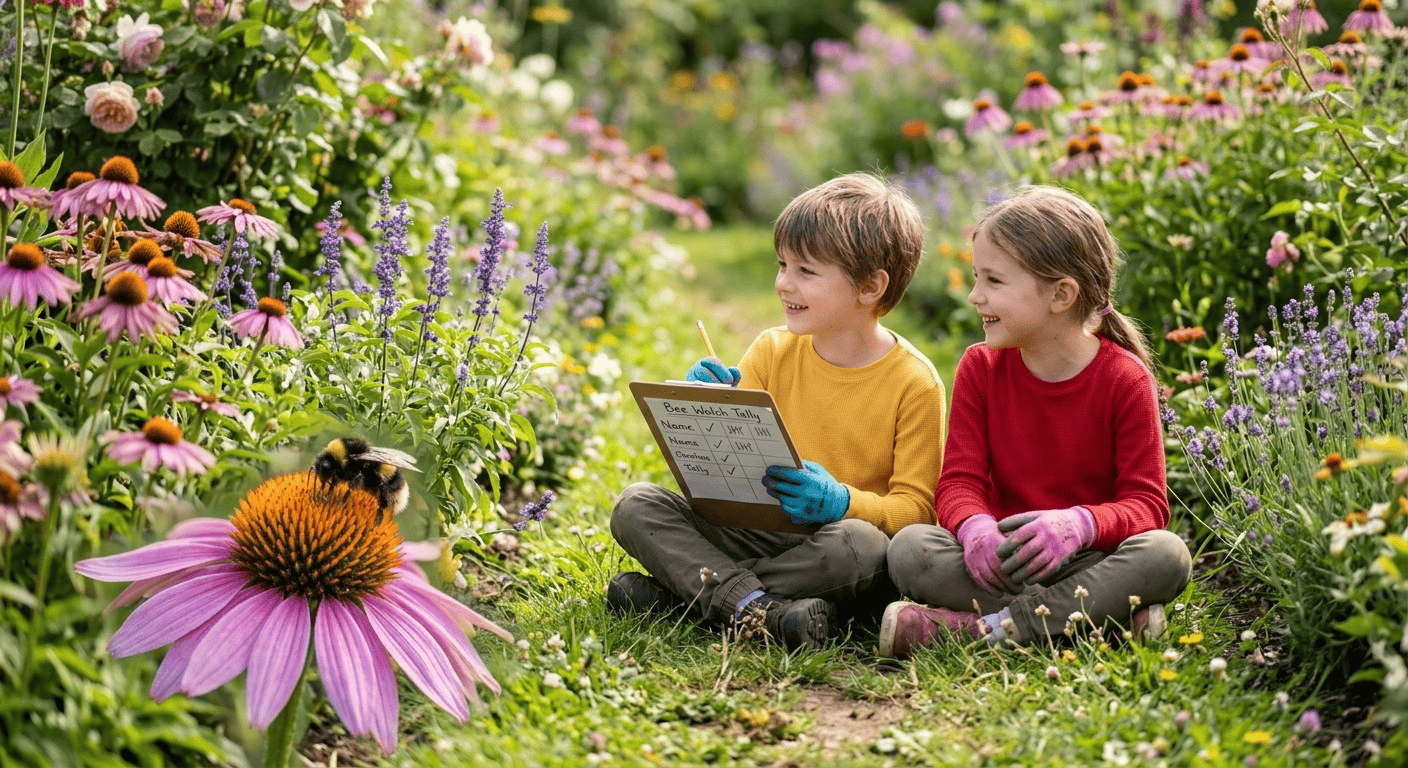
Pollinators are the poster children of citizen science, and for good reason: they’re easy to spot, endlessly fascinating, and vital to our food supply. The Great Sunflower Project (https://www.greatsunflower.org/) (external link) asks families to plant a specific sunflower variety and count pollinator visits, but you can adapt the method to any flowering plant.
How to do it safely: No catching, no touching. Sit near a flower patch and use a timer. Count how many bees, butterflies, and other insects land on a single bloom in a 10-minute window. Wear shoes and avoid getting too close to hives; if a wasp shows up, just freeze and then slowly move back. Long sleeves and pants are smart if you’re near thicker brush.
Biology tie-in: This project brings plant reproduction to life. After a few counts, ask your child, “Why do you think the lavender gets more visitors than the rose?” You’ll be discussing nectar guides, flower shapes, and coevolution without a single flashcard. For a deeper dive, sketch the visitors in a journal our Ultimate Guide to Nature Journaling with Kids has templates and prompts to make recording a joy.
Project 3: Soil Safari – Unearthing Tiny Life
Beneath every footstep lies a universe. A soil safari is one of those safe biology experiments children will beg to do again, because it involves digging, sifting, and maybe a few beloved “ick” moments. The goal is to see what macroinvertebrates (bugs you can see with your naked eye) live in different soil types. You can contribute to ongoing soil biodiversity projects by using an app like iNaturalist to record your finds.
How to do it safely: Pick a spot in the yard, away from chemical treatments. Use a trowel to dig a small hole, wear gloves, and place the soil on a light-colored tray. An adult can build a simple Berlese funnel, a soda bottle, a mesh screen, and a light above, that gently coaxes tiny creatures down into a viewing container. Emphasize that we look, maybe photograph, and then return everything to its home. Wash hands thoroughly after.
Biology tie-in: You’re exploring decomposition, food webs, and adaptation. Why do pill bugs curl up? Why are some worms darker? Tie it to the nutrient cycle and suddenly your child understands why leaves disappear into the ground each fall. If you want to monitor conditions, our post on building a Simple DIY Weather Station for Kids helps track soil temperature and moisture alongside your finds.
Project 4: Pond Dipping & Water Quality – Aquatic Adventures
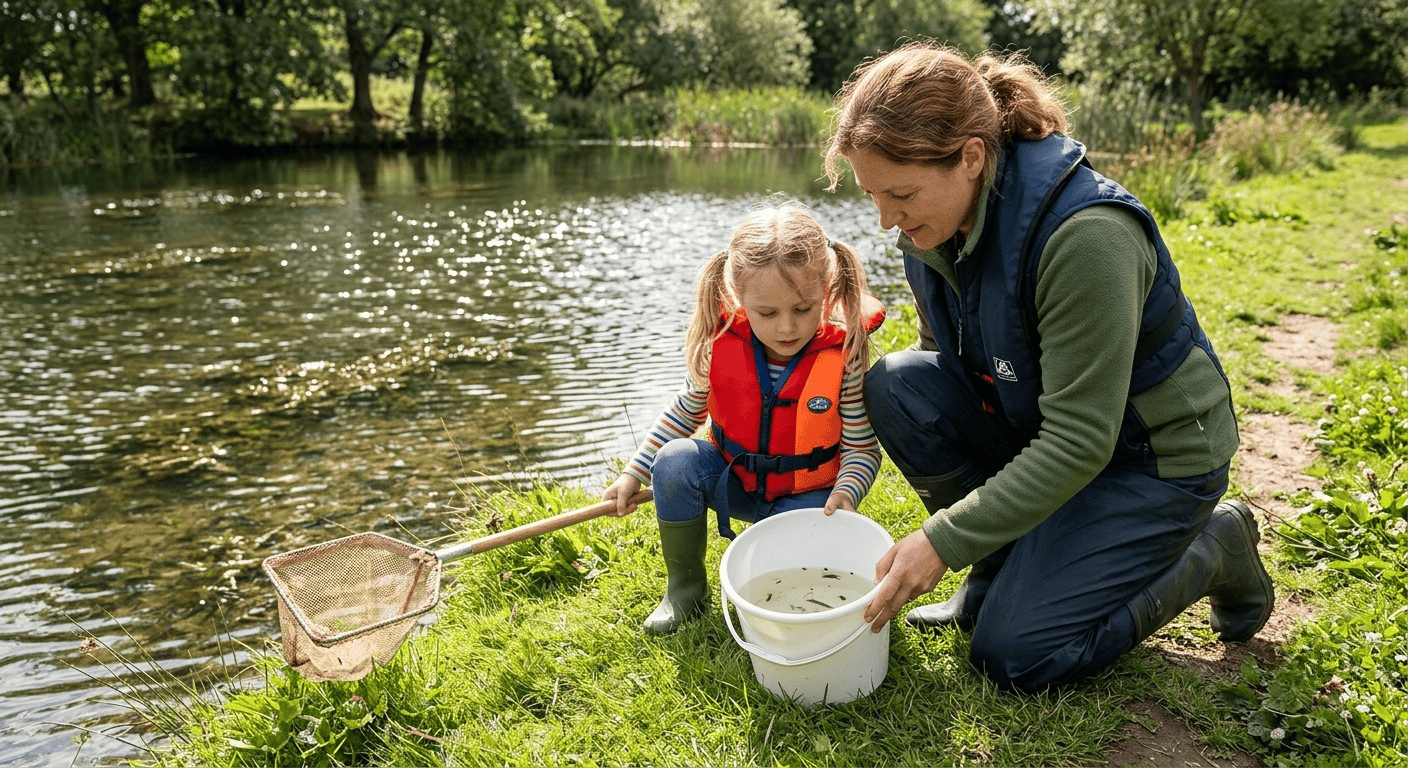
A net, a bucket, and a shallow, safe body of water are your tickets to an aquatic discovery lab. The EarthEcho Water Challenge (https://www.monitorwater.org/) (external link) encourages families to test basic water quality parameters and report their findings, but even without a chemistry kit you can look for “indicator species”, critters whose presence tells you the water is clean.
How to do it safely: This is an adult-led activity all the way. Choose a calm, shallow pond or stream edge with no fast current. Always stand on a stable bank; no wading unless the water is ankle-deep and clear, and even then, wear water shoes. Scoop some water and mud into the bucket, then pour it into a white ice cube tray so kids can see what’s there. Never put hands in the mouth before washing.
Biology tie-in: Find mayfly nymphs? That’s a sign of low pollution. Lots of leeches and no mayflies? The water may be stressed. This is a tangible lesson in ecology and environmental health. You can also scoop a jar of water and let it settle to look for microorganisms under a microscope. Between the squirming and wiggling, kids absorb biology at warp speed.

Project 5: Plant Phenology – Watch the Seasons Change
Phenology is the study of seasonal plant and animal life-cycle events, bud burst, first flower, fruit ripening. The USA National Phenology Network’s Nature’s Notebook (https://www.usanpn.org/natures_notebook) (external link) invites volunteers to observe a single plant or a whole yard over time. It’s one of the calmest, most reflective DIY citizen science for kids projects, requiring nothing but a calendar and a keen eye.
How to do it safely: Pick a plant you can identify with certainty (a lilac bush, a maple tree, a patch of coneflowers). Avoid anything with thorns, irritating sap, or look-alikes that might be toxic. Teach the “look but don’t nibble” rule. Before you start, take a photo of your plant at the same spot each week to build a visual timeline.
Biology tie-in: This is plant life cycles in real time. Your child learns that biology isn’t static, it’s a movie, not a snapshot. Link it to climate: “Our lilac bloomed a week earlier than last year; what does that tell us?” You’re weaving together botany, climate science, and data collection without a single lecture.

How to Turn Observations into Data (And Why It Matters)
You’ve got a notebook full of tally marks and sketches, now what? The magic of DIY citizen science for kids comes alive when that information leaves your kitchen and joins a global dataset.
Most projects have a simple web portal or mobile app where you can log findings in under five minutes. Here’s how to make the most of it:
Take a photo first. A quick snapshot with your phone timestamps the observation and helps experts verify it later.
Use a consistent format. Teach your child to always note the date, time, weather, and location. This is the “control” part of the scientific method.
Compare and discuss. Before uploading, pull up last month’s data. Are there more birds now? Fewer bees? Why might that be? This wraps critical thinking into the habit.
Celebrate the submission. Every checklist submitted is a tiny act of contribution. Some platforms even show your data on a map, which kids find thrilling.
For beautiful, screen-free recording, I can’t recommend our Ultimate Guide to Nature Journaling with Kids enough. It turns data collection into an art project, and many children absorb the science better when they’ve drawn it themselves.
FAQs About DIY Citizen Science for Kids
Is citizen science really safe for young children?
Absolutely, as long as you stick to observation-based projects and follow the safety tips above. Most safe biology experiments children can do involve watching, counting, and recording, not risky handling. With an adult filtering the experience, even a preschooler can count ladybugs on a leaf.
What if we don’t have a big backyard?
No backyard? No problem. A window bird feeder, a container garden on a balcony, or a walk to a local green space are all you need. Many projects, like cloud or squirrel counts, can be done right from the sidewalk. This kind of teaching biology at home adapts to whatever patch of nature you have.
How do I keep my child engaged long-term?
Follow their curiosity, not a schedule. If they fall in love with birds, ride that wave and let the soil safari rest. Rotate projects seasonally, phenology in spring, water quality in summer, bird counts in winter. Make it social by inviting a neighbor or cousin to join; citizen science is even better when shared.
Do we need special equipment?
Rarely. A notebook and a pencil will get you through most activities. Binoculars, a magnifying glass, and a smartphone are nice bonuses but never prerequisites. That’s the heart of DIY citizen science for kids: access over expense.
Key Takeaways: DIY Citizen Science for Kids
Real science, real impact. Your child’s observations feed into genuine research, making teaching biology at home purposeful and exciting.
Safety is simple. With supervision, gloves, and a “look, don’t touch” mindset, these safe biology experiments children can do become a habit of joyful discovery.
Projects fit every space. From a window feeder to a local pond, you don’t need a sprawling forest to start DIY citizen science for kids.
Data wraps it all together. Submitting checklists builds digital literacy and shows children that science is a collaborative, living process.
Curiosity leads the way. Follow your child’s interest, birds, bugs, flowers, water, and the biology lessons will take care of themselves.
Ready to turn your home into a biology lab? Pick one project and get started this weekend. Watch your child’s eyes light up when they realize their scribble in a notebook matters to scientists halfway across the world.
Have questions, a story to share, or a project you’d love to see featured? We’d be genuinely thrilled to hear from you.
Contact us at [[email protected]] for inquiries, guest project ideas, or just to say hi. Let’s grow the next generation of biologists together, one backyard count at a time.